Hiring an offshore WordPress developer can save you a lot of money, but only if you hire the right person. Most horror stories (missed deadlines, half-finished sites, a developer who disappears with your login details) are avoidable with a few simple checks before you pay anything.
I work remotely with small businesses in the USA, UK, Europe, Canada, Australia and New Zealand, so I see this from both sides. This checklist is what I would tell a friend who is about to hire a remote developer, whether they hire me or someone else.
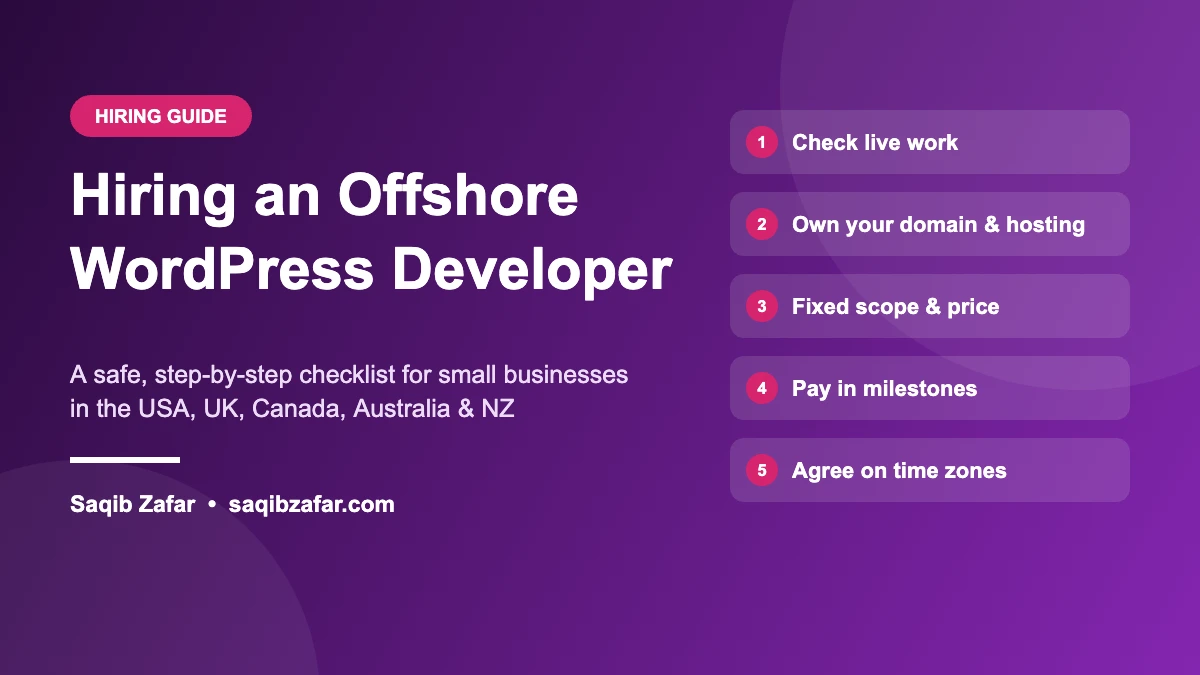
Short version: look at live websites they have built, keep the domain and hosting in your own name, agree a written scope and fixed price, and pay in milestones. Do those four things and most of the risk disappears.
Why hire an offshore WordPress developer?
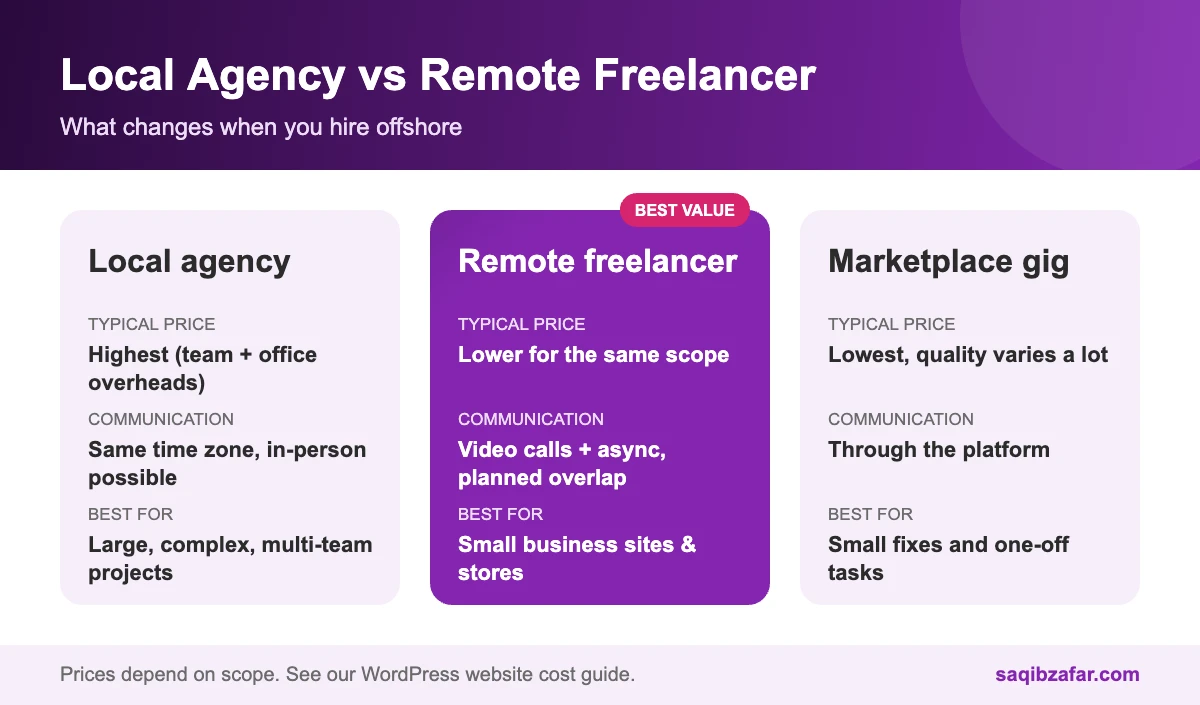
Web development happens online, so where your developer lives changes the price much more than the quality. The same small business website can cost several times more from a big-city agency than from an experienced remote freelancer, mostly because of office and staff overheads. If you want to see real price ranges for your country, read my WordPress website cost guide.
The other benefits are less obvious: you work directly with the person building your site (no account manager in the middle), and a developer in a different time zone can often work while you sleep, so you wake up to progress.
The offshore WordPress developer checklist
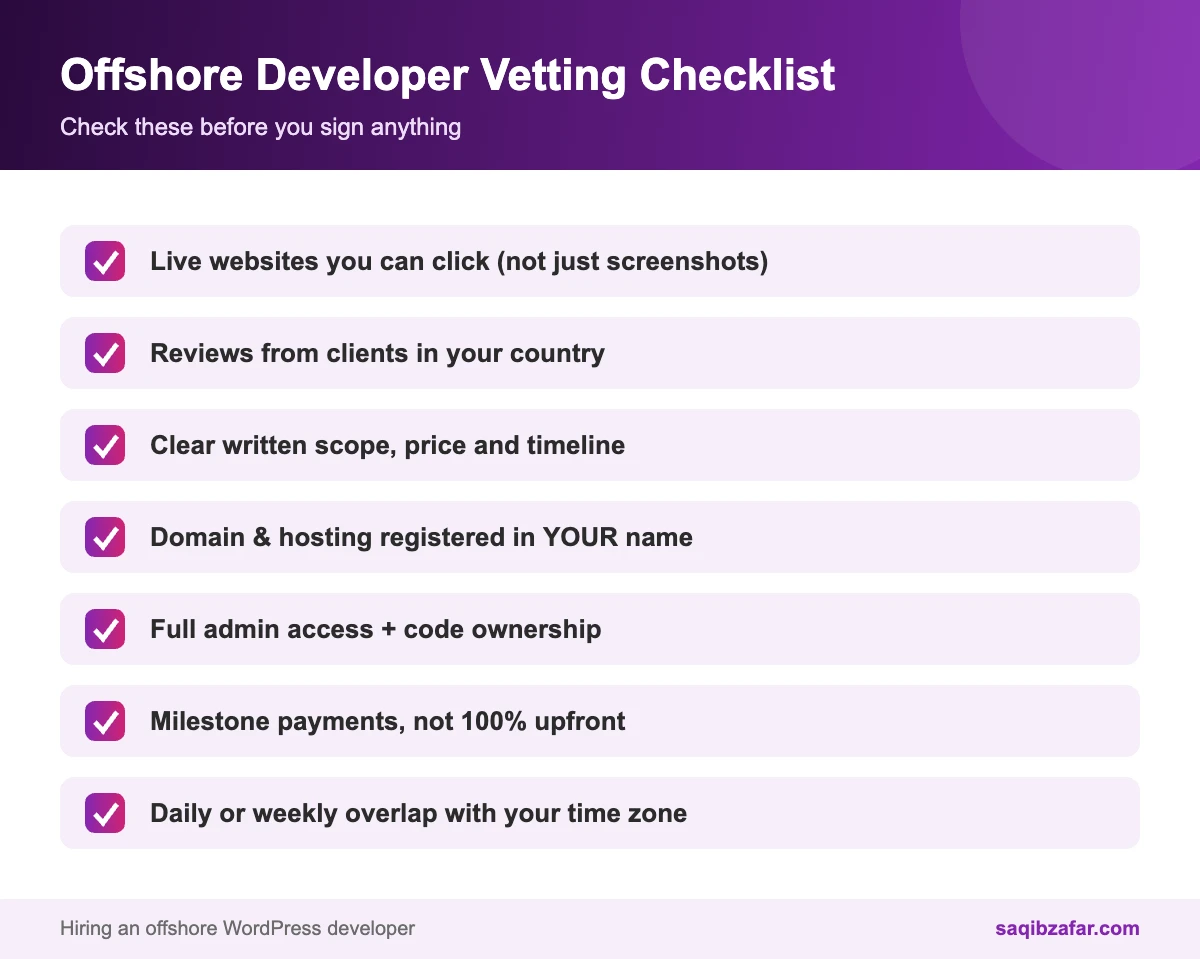
Use this list before you sign anything or send a deposit:
1. Check live websites, not screenshots
Anyone can put nice screenshots in a portfolio. Ask for links to live sites, open them on your phone, and check that they load quickly and work properly. If possible, pick projects similar to yours: an online store if you need a store, a service business site if you are a plumber or consultant. You can see my live client projects here.
2. Read reviews from clients in your country
Reviews on Upwork, Fiverr, Google or LinkedIn from clients in your own market tell you two things: the developer can deliver, and they can communicate with someone like you. Look for comments about deadlines, communication and support after launch, not just “great work”.
3. Keep the domain and hosting in your name
This is the most important rule. Your domain name and hosting account must be registered to you, with your email address and your payment card. The developer can be added as a user. If anything goes wrong, you still own your website and can hand it to someone else.
4. Get a written scope, price and timeline
A good developer will ask questions before quoting. The proposal should list the pages, features, number of revisions, what you need to provide (text, photos, logins), the launch date and what happens after launch. “A professional website” is not a scope.
5. Pay in milestones
A common, fair structure is 50% to start and 50% at launch, or three payments for bigger projects. Avoid paying 100% upfront to someone you have never worked with. If you hire through a marketplace, use its escrow or milestone system.
6. Agree on communication and time zones
Agree how you will talk (email, WhatsApp, Slack or video calls), how often you get updates, and a regular time when you are both online. Even one or two hours of overlap a day is enough for most website projects.
7. Make sure you get full access at the end
At handover you should have the WordPress admin login (as an administrator), hosting access, any premium plugin licences in your name, and a recent backup. Ask for a short document listing the plugins used and anything special about the setup.
A simple hiring process that protects you
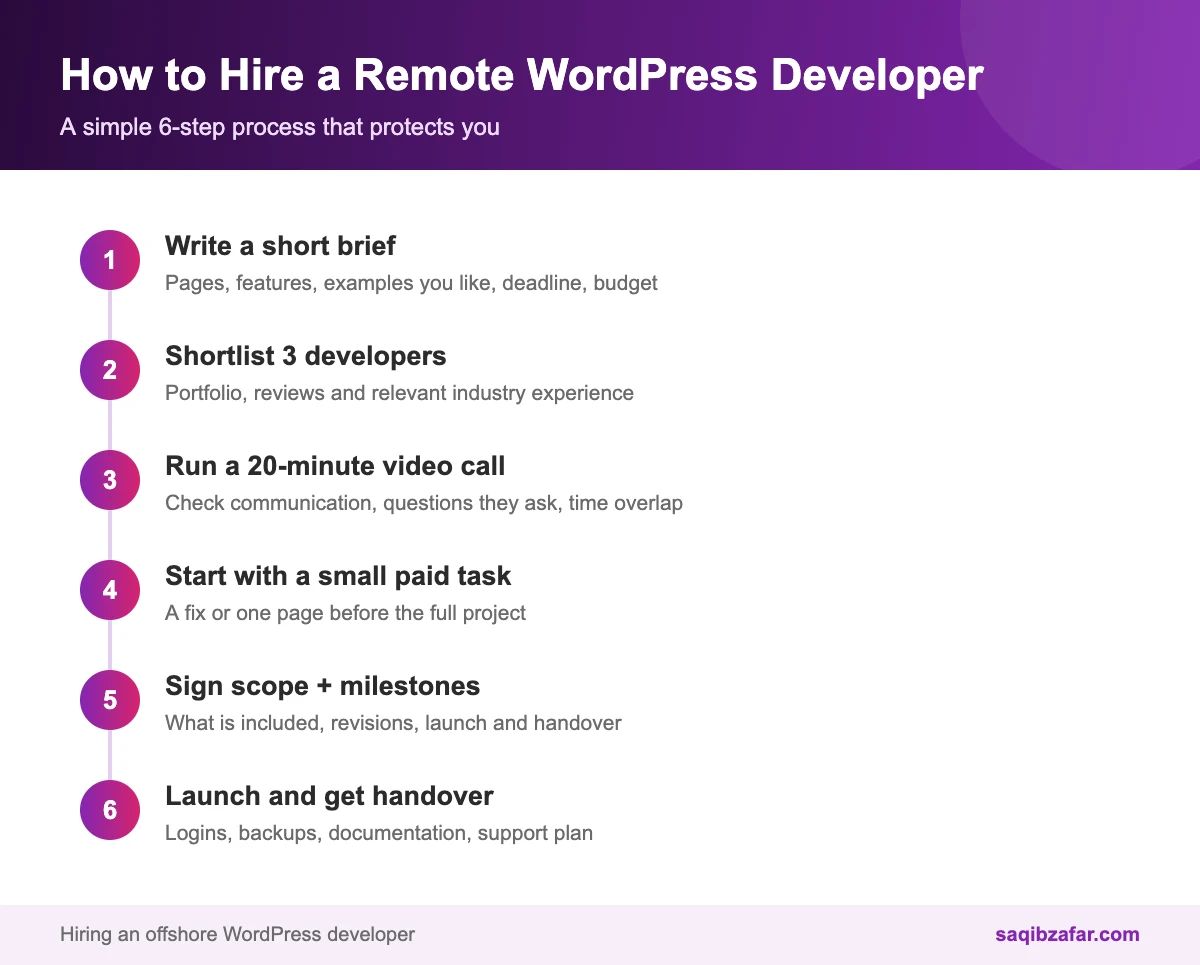
A small paid test, such as fixing a bug or building one page, is the best predictor of how the full project will go. It costs little, and you will quickly see the quality of work and communication.
Red flags to watch out for
- They want the domain or hosting registered in their name.
- They ask for 100% payment upfront on a first project.
- The portfolio has no live links, or the links are broken.
- They agree to everything instantly without asking questions.
- They are unclear about who owns the code, theme or plugin licences.
- You cannot get a straight answer about the launch date.
Looking for a reliable remote WordPress developer?
I build fast, SEO-ready WordPress websites and WooCommerce stores for small businesses, with clear fixed pricing, milestone payments and full ownership for you from day one.
Frequently asked questions
Is it safe to hire an offshore WordPress developer?
Yes, if you follow the checklist above. Most of the risk comes from paying everything upfront or letting someone else control your domain and hosting. Keep ownership and pay in milestones, and the risk is low.
How much does an offshore WordPress developer cost?
It depends on the scope and the developer’s experience, but remote freelancers are usually much cheaper than local agencies for the same small business project. See typical prices by country in my WordPress website cost guide.
What if the developer disappears halfway through?
If the domain, hosting and WordPress admin account are in your name, another developer can pick up the work. That is exactly why ownership matters more than anything else on this list.
Ready to start your project?
If you need a new website or want to fix an existing one, take a look at my WordPress website development services and website SEO services, or send me a message for a free audit and quote.